
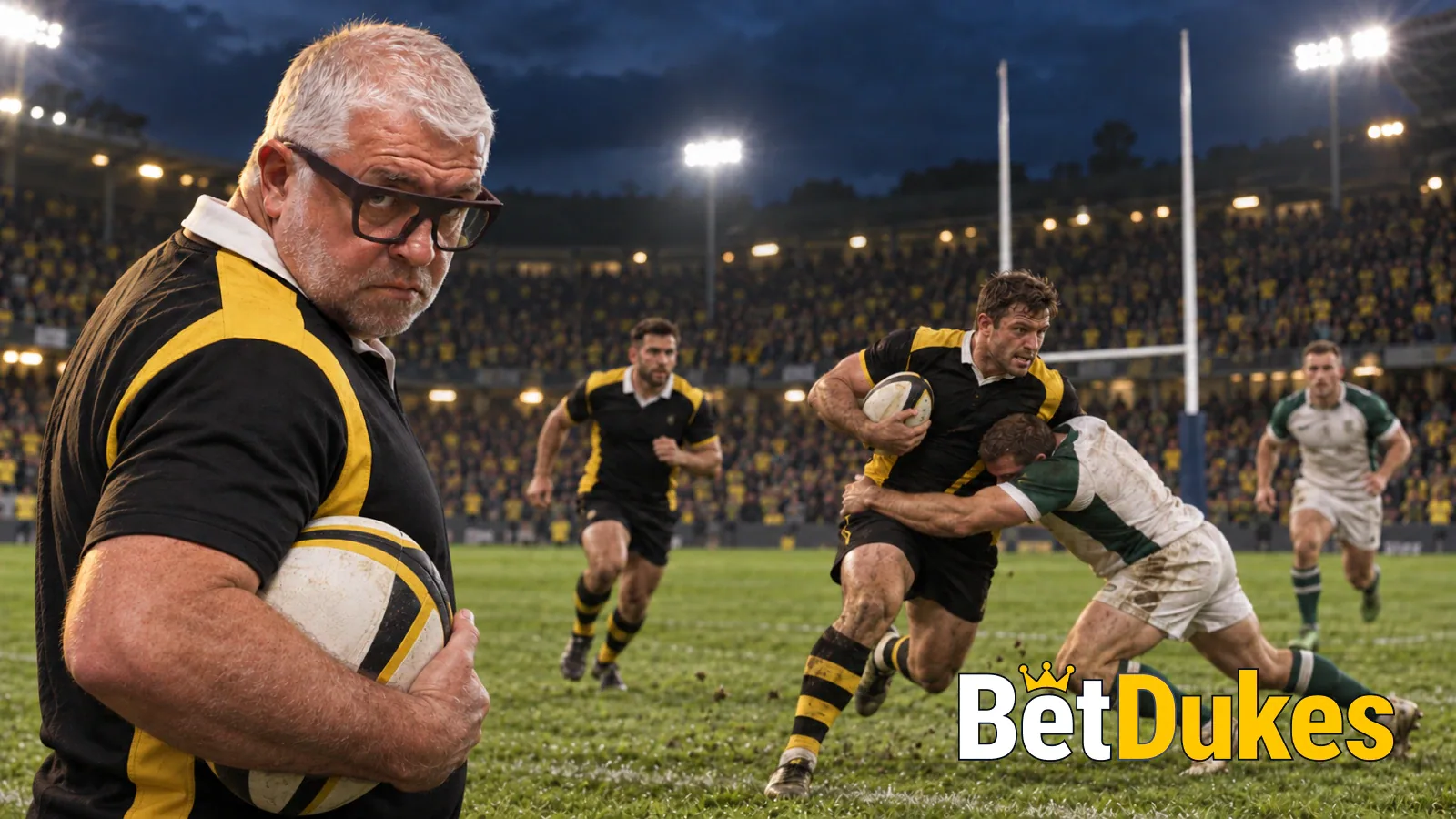

Rugby is two sports sharing a name. Union puts fifteen players a side on the field, league thirteen, and the two missing men are why the games look nothing alike. Union's extra pair go into the scrum and the line-out, where territory is won slowly. League gets the ball back up the field and takes it in again.
Scoring runs on the same idea and different numbers. A try, the ball grounded over the line, is worth five points in union and four in league, and the conversion kicked afterwards adds two in both. Union pays three for a penalty kick and three for a drop goal; league pays two and one.
Both codes are priced here, before kick-off and while the match runs, with the competition outrights open through the season.
The competitions
The two codes keep different diaries. Union's club season starts in late September and runs to a June finish, with the Six Nations dropped into the middle. League is well under way by then: it opens in February and ends in early October. The overlap runs to about half the year, which is more rugby than the calendar needs.
- Premiership Rugby. England's top club league, late September into June, every club playing home and away before the leading sides meet in semi-finals and a final.
- Six Nations. England, France, Ireland, Italy, Scotland and Wales play each other across February and March. It is the international break that sits in the middle of everyone's club season.
- Champions Cup. The cross-border club competition, drawing on the leading clubs of England, France, Ireland, Italy, Scotland, Wales and South Africa. It runs into the new year and builds to a final in the spring.
- United Rugby Championship. One league for clubs from Ireland, Italy, Scotland, South Africa and Wales, late September into June, with knockout rounds to finish.
- Top 14. France's top division, September into June.
- Super League. England's senior league competition, February through the summer, with play-offs and a Grand Final at a neutral ground in early October.
- NRL. Australia's senior league competition, March into September, finishing in early October.
The markets
Match winner
A rugby match can finish level, so the board runs two versions. The three-way match result prices the draw as a selection of its own. The two-way match winner offers the sides alone. Both settle on eighty minutes, stoppage time included, so golden point, the sudden-death period some league competitions play on a draw, arrives too late to count.
The handicap
A handicap gives one side a head start in points, so a heavy favourite still has to beat the board as well as the opponent.
Back a team at plus eleven and they can lose by ten and still win the bet, while a favourite at minus eleven must win by twelve. A line that lands exactly level is void, which is why so many of them carry a half point.
Total points
Total points is an over or under on everything both teams score. Union builds a score in fives and sevens with the odd three, league in fours and sixes, so the same line means different things in each. A total finishing exactly on the line is void, and an abandoned match voids bets that were not already decided.
Outrights
An outright backs a team to win a competition rather than a match, and it stays open for as long as the season takes. Most of the leagues here finish with play-offs, and the rules settle a league outright on the regular-season table without allowing for them.
Check which question a price is asking: the table, or the trophy.
Union and league each get their own section in the Sports Betting Rules, and the wording is not identical between them. Check which one applies before you back a line.
In-play
A rugby match is priced from the first whistle to the last, and the match markets re-cut as the score moves. A converted try changes the scoreboard and the handicap in the same motion.
Any price you see away from the sportsbook is a photograph of a moment that has already passed.
A yellow card sends a player to the sin bin for ten minutes in both codes, and a side a player short gives up ground it does not get back. Ten minutes is a long time to defend with fourteen — longer with twelve.
The last ten minutes move quickest, with fresh forwards arriving off the bench against tired legs and one score still able to turn a result over. Weather does its work more quietly: a greasy ball goes to ground more often than it goes to hand, and a total that looked low before kick-off starts looking generous.
What to look at before you bet
- Home advantage. A familiar pitch and a home crowd count in both codes, and they count for more in the competitions that send clubs across borders and time zones to play a league fixture.
- Weather and the kicking game. Wind and rain cut down how far a side can play through the hands and put more of the match through the boot. That suits the better kicking team and drags a total-points line down with it.
- Team news and the bench. A missing goal-kicker or a rebuilt front row moves a handicap on its own. The bench decides what the closing quarter looks like, which is a different question from who is better over eighty minutes.
- The rhythm of the code. League restarts play quickly after a tackle and sends the forwards straight back into contact, which makes for a faster, higher-scoring match. Union's set pieces slow it down, and a tight low-scoring arm-wrestle is a normal result rather than a bad one.
- The bonus point. Union's leagues award competition points for the result and add another for scoring a set number of tries, and another again for losing narrowly, with thresholds set per competition. It is why a beaten side keeps attacking. League tables have no such thing.
- The NRL finals. The leading sides play a finals series of several weekly rounds before the Grand Final, so a whole season can turn on the week a team draws the wrong opponent.
The rugby quick guide
- Start with the arithmetic. Fives and sevens in union, fours and sixes in league.
- Read the team sheet first. A goal-kicker and a front row move a handicap on their own.
- Look out of the window. Wind and rain shift a total further than form does.
- Decide what you actually think. Who wins and by how much are different bets.
- Wait for the bench. Tight matches are decided after the replacements arrive.
- Check whose rules apply. The codes settle some of the same markets differently.
Union and league each have their own card, and the Sports Betting Rules keeps a rugby section for each of them.