
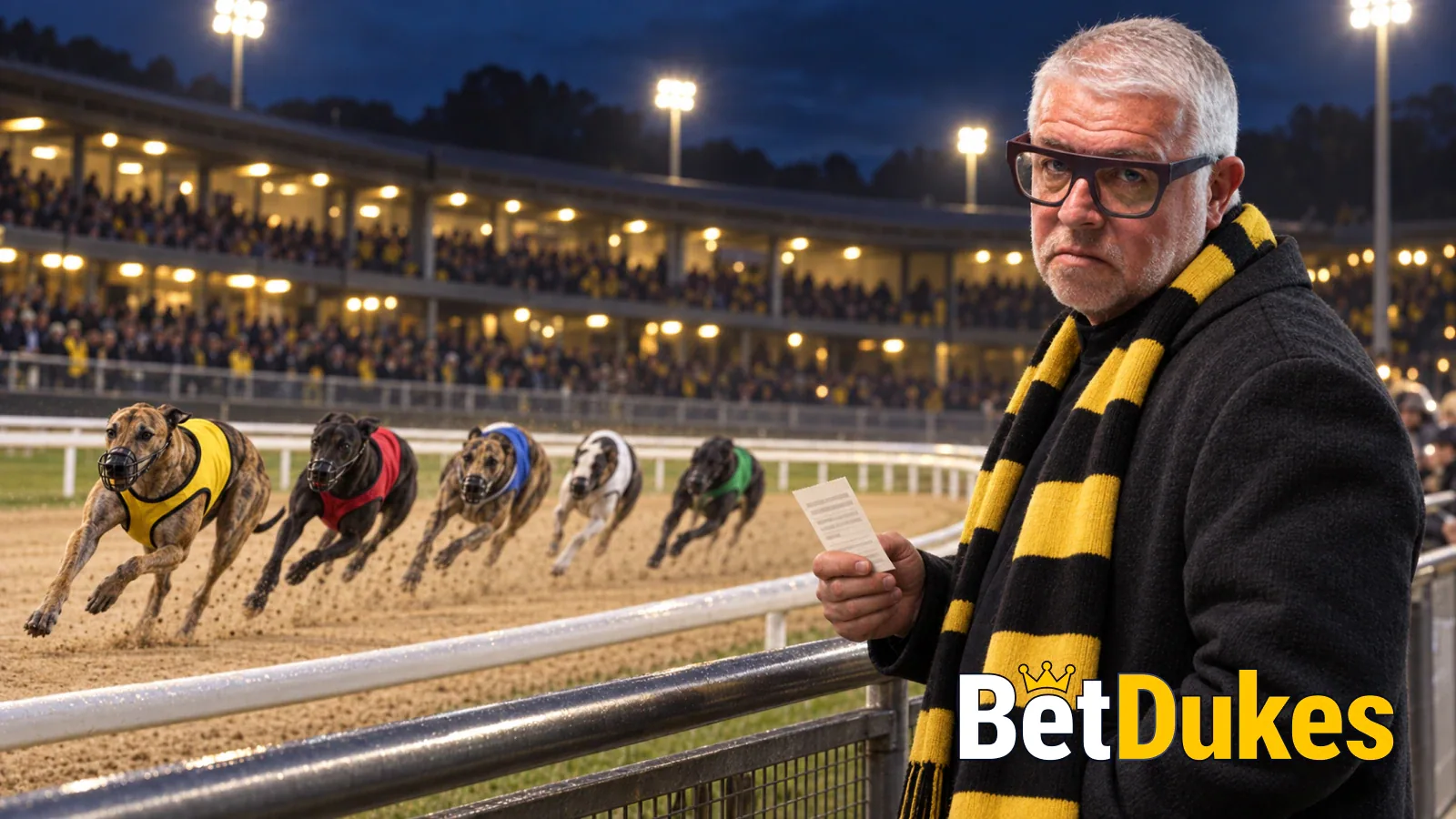

A greyhound race is six dogs, six numbered starting boxes called traps, and about thirty seconds of running. The number on the trap does more work here than the name of the dog in it, because a greyhound is drawn into its trap for a reason, and that reason often decides the race before the first bend.
The cards come from the UK tracks, afternoon and evening, every day of the week. Win and each-way are the markets on them, and a race is priced from the moment the card goes up until the traps open.
The cards
Greyhound racing works two shifts.
The afternoon meetings begin in the early afternoon, and the evening cards carry the sport on into the night. On a busy day four tracks overlap and put up forty races between them.
On one recent afternoon Kinsley, Sheffield, Hove and Towcester were all racing at once. Which tracks are on changes from one day to the next, and the circuit runs from the North East down to the South Coast and across into Wales.
The English Greyhound Derby is the sport's showcase, a knockout run down through rounds from the spring to a final in early summer.
Its host track has moved over the years, which makes the Derby a point in the season rather than a place on a map.
How a race works
- The traps. Six numbered boxes sit across the track, one dog loaded into each, and the fronts fly up together. Every trap has a colour that the dog wears on its jacket, which is how you find your runner once all six are moving.
- The draw. Greyhounds are seeded before the draw by how they have run before: a railer hugs the inside rail, a wide runner takes the outside, and a middle runner sits between them. The first wide runner drawn gets the highest trap in the race and the first railer the lowest, so trap one leans inside and trap six leans wide.
- The first bend. Six dogs a couple of strides out of the boxes arrive at one bend together, and most races are settled in the seconds before they reach it. A wide runner drawn on the inside has the whole field to cross first, which is a lot to ask of thirty seconds.
- The trip. Each track runs its races over set distances, from a sprint up to a staying trip several hundred metres longer. Early pace counts for more the shorter the race is, and a dog built for a sprint does not always settle over the longer trip.
- The grade. Tracks sort their dogs into grades, top class downwards, so the grade is the standard of company a race is run in. A dog dropping a grade or two is meeting weaker opposition than it met last time, which usually says more than the finishing position does.
- SP and early prices. The starting price, written as SP, is the price returned at the moment the race goes off. An early price is one taken before that and held at the figure you took.
- Reserves and vacant traps. A late withdrawal is filled from a reserve list rather than leaving the race a dog short, so the runner in a trap is not always the one that declared first. A trap left empty is a vacant trap, and the draw treats it as a middle runner rather than ignoring it.
The markets
Win
Back one trap to win the race. Back it by number and you get whichever dog runs in that trap, reserve or not, because the number is what the bet is on. Ask for the dog by name and a non-runner voids the bet instead.
Each-way
Each-way splits your stake in two: half backs the dog to win, and half backs it to place, a place being one of the finishing positions the race pays out on. How many places that is, and at what fraction of the odds, is shown on each race and moves with the size of the field.
Take an early price, then watch a dog come out of the race, and your bet settles at SP rather than at the figure you took.
The Sports Betting Rules give greyhound racing a heading to itself, and where that heading disagrees with the general racing rules, the greyhound wording wins. It is also where a dead heat is settled, the stake split between the dogs that cross together, and where you find what becomes of a race abandoned and re-run later the same evening.
In-play
A greyhound price runs until the traps open and moves the whole way. Money goes on late, the card can change late, and the number against a trap an hour before the off is rarely the number it goes off at. Thirty seconds does not leave much room for second thoughts.
A reserve going into a trap re-cuts everything around it. Put a wide runner into trap two in place of a railer and the shape of the first bend changes, and the prices follow. Bets placed after the official off are void, win or lose, and a price quoted away from the racing list carries the time it was taken.
What to look at before you bet
- The trap and the running style. Find out whether the dog is a railer, a middle runner or a wide runner, then look at the trap it has drawn. A railer low and a wide runner high are dogs in the right place. The other way round and they have work to do before they can start racing.
- The grade it is running in. A drop of a grade or two means weaker company than last time, and a rise means the opposite. Grade moves tell you more about a dog's chance than a finishing position does.
- The trip. A dog that has only shown early pace over a sprint is being asked something different over a staying trip, and the difference usually shows at the end of the race rather than the start.
- The track and recent form. A dog racing well at its home track, over its usual distance, from a trap that suits it, is a different proposition from the same dog on an unfamiliar circuit. Form does not always travel.
- Late changes. Reserves go in close to the off and traps can be left vacant, so the six names on a card in the morning are not always the six that run.
- Which price you are taking. An early price holds the figure you took; SP takes whatever the market returns at the off. Which one you want depends on whether you expect the dog to shorten or drift once the money arrives.
The greyhound racing quick guide
- Start with the trap. Check which dog is in which box, and how each of them likes to run.
- Read the grade. A dog dropping a grade is meeting weaker company than it met last time.
- Check the trip. Early pace decides the sprints, and a staying trip asks a different question.
- Pick your price. Take the early price if you expect the dog to shorten, and leave it at SP if you do not.
- Look at the traps again before the off. A reserve can be in one of them, and a bet on the number goes with the box rather than the dog.
The cards open the day's racing, the horses are the other half of it, and the greyhound section of the Sports Betting Rules covers the part a thirty-second race never has time to explain: non-runners, reserves and the trap that went off empty.